

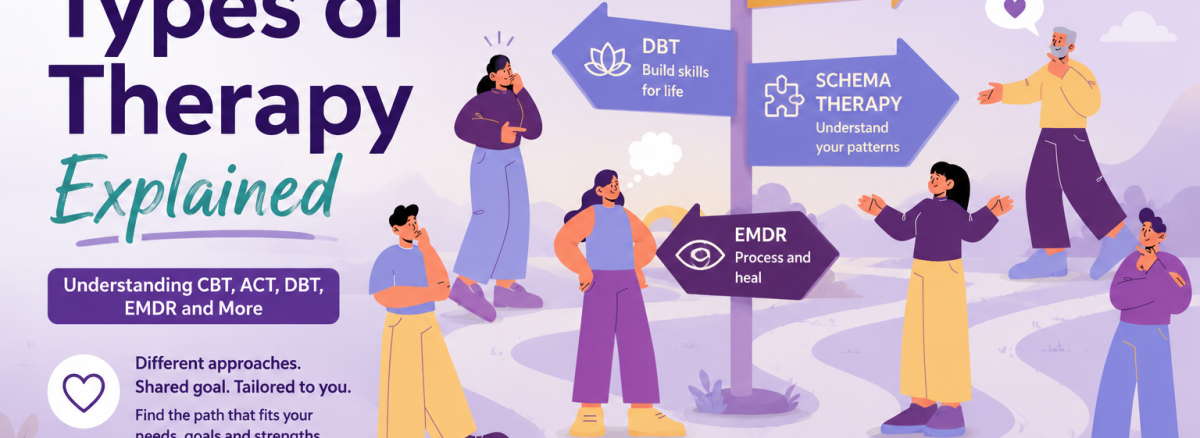
Types of Therapy: Which Approach Is Right for You
Most people have heard of therapy. However, fewer people realise that there are many different types of therapy, each with its own goals, techniques, and ways of understanding human experiences.
If you’ve ever looked for a psychologist, you’ve probably come across terms such as Cognitive Behavioural Therapy (CBT), Acceptance and Commitment Therapy (ACT), Dialectical Behaviour Therapy (DBT), Schema Therapy, or EMDR. For many people, these labels can feel overwhelming.
The good news is that you do not need to become an expert in therapy models before seeking support. Understanding the main types of therapy can simply help you feel more informed about the options available and the questions you may wish to ask.
What Are the Different Types of Therapy?
Different types of therapy are different frameworks that psychologists use to understand difficulties and support change. Think of them as different “lenses” through which a psychologist might view a situation.
For example, one approach might focus on the relationship between thoughts, emotions, and behaviours. Another might focus on emotional regulation skills. A third might explore long-standing patterns that developed through life experiences.
Importantly, no single approach is considered the best for every person or every concern.

Cognitive Behavioural Therapy (CBT)
Cognitive Behavioural Therapy (CBT) is one of the most widely researched and commonly used psychological approaches.
CBT is based on the idea that our thoughts, emotions, physical sensations, and behaviours influence one another. The goal is not to “think positively” but rather to identify unhelpful patterns and develop more balanced and useful ways of responding.
CBT may include strategies such as:
- Identifying thinking patterns.
- Behavioural experiments.
- Gradual exposure to fears.
- Problem-solving skills.
- Activity scheduling.
CBT has a strong evidence base for a range of concerns, including anxiety, depression, and some phobias.
However, CBT is not the only effective therapy available, and some people find that other approaches better match their goals and preferences.
Acceptance and Commitment Therapy (ACT)
Acceptance and Commitment Therapy (ACT) focuses on developing psychological flexibility.
Rather than trying to eliminate difficult thoughts and emotions, ACT encourages people to learn how to make space for these experiences while continuing to move towards what matters most to them.
ACT often explores:
- Personal values.
- Acceptance of difficult internal experiences.
- Mindfulness skills.
- Self-compassion.
- Committed action towards meaningful goals.
Many people find ACT particularly helpful when they feel stuck fighting against thoughts or emotions that cannot simply be switched off.
Dialectical Behaviour Therapy (DBT)
Dialectical Behaviour Therapy (DBT) was originally developed to support people experiencing intense emotional distress and difficulties regulating emotions.
DBT focuses on four main skill areas:
- Mindfulness.
- Distress tolerance.
- Emotion regulation.
- Interpersonal effectiveness.
Many people appreciate the practical nature of DBT and its emphasis on building concrete coping skills.
Schema Therapy
Schema Therapy explores long-standing patterns that influence how people see themselves, other people, and the world around them.
These patterns, known as schemas, often develop through early life experiences and can continue to shape relationships, self-esteem, and coping styles into adulthood.
Examples of common schemas include beliefs such as:
- “I am not good enough.”
- “People will eventually leave me.”
- “I must meet extremely high standards.”
Schema Therapy can be particularly helpful when difficulties feel deeply ingrained or recurring across different areas of life.
EMDR and Trauma-Focused Therapies
When people think about therapy, they often imagine talking through problems. However, some approaches focus specifically on processing traumatic or distressing memories.
Eye Movement Desensitisation and Reprocessing (EMDR) is one example.
Trauma-focused approaches aim to help the brain process experiences that may continue to trigger distress long after the original event has passed.
Trauma therapy is not only relevant for major traumatic events. It may also be helpful for people who have experienced chronic stress, bullying, relationship difficulties, medical trauma, or other significant life experiences.
If you are interested in EMDR therapy, the EMDR International Association provides information about the approach and offers a directory to help people locate trained EMDR practitioners.
Person-Centred and Humanistic Approaches
Some types of therapy place less emphasis on structured techniques and more emphasis on the therapeutic relationship itself.
Person-centred approaches focus on creating a safe, supportive, and non-judgemental environment where people can explore their experiences openly.
These approaches recognise that feeling understood, accepted, and genuinely heard can be a powerful catalyst for growth and change.

Which Type of Therapy Is Best?
One of the most common questions people ask is:
“Which therapy works best?”
The answer is not as straightforward as choosing the “best” therapy model.
Research consistently suggests that successful outcomes are influenced by many factors, including:
- The quality of the therapeutic relationship.
- The therapist’s skills and experience.
- The client’s goals.
- The client’s readiness for change.
- The fit between the person and the therapeutic approach.
What works well for one person may not be the right fit for someone else.
Do Psychologists Use More Than One Approach?
Yes.
Many psychologists integrate strategies from multiple evidence-based approaches rather than strictly following a single model.
For example, a psychologist may draw on:
- CBT strategies to understand thinking patterns.
- ACT techniques to build psychological flexibility.
- DBT skills to support emotional regulation.
- Compassion-focused approaches to address self-criticism.
This allows therapy to be tailored to the individual rather than expecting the individual to fit a particular model.
Finding the Right Fit
Choosing a psychologist is often more important than choosing a therapy label.
When considering support, it can be helpful to ask:
- What are my goals for therapy?
- Do I want practical strategies, deeper exploration, or both?
- Do I prefer a structured or flexible approach?
- Have I tried therapy before, and what was helpful or unhelpful?
A good psychologist will work collaboratively with you to understand your goals and adapt their approach accordingly.
Looking for Therapy in Mount Waverley?
At aMAZEin’ Minds Psychology, our psychologists draw from a range of evidence-based approaches, including CBT, ACT, DBT-informed strategies, strengths-based practice, and neurodiversity-affirming approaches.
We work with children, adolescents, and adults across a wide range of concerns, including anxiety, emotional regulation, burnout, neurodivergence, learning differences, and life transitions.
Or contact our team to discuss which support option may be the best fit for you.
 Call us: (03) 7046 4528
 Email: info@amazeinminds.com.au
 Contact us online »
 www.amazeinminds.com.au
 We support clients across Melbourne’s eastern suburbs, including Glen Waverley, Chadstone, Burwood, Ashwood, Oakleigh, and surrounding areas, with telehealth appointments also available across Australia.